






Not enough bone? We build it back.
The three things worth knowing first
Bone goes where it is used
Your jawbone is kept in shape by the tooth root pressing into it every time you chew. Take the root away and the bone slowly wastes.
That is why a gap left for ten years is a harder case than one left for ten months. It is also why we would rather see you sooner than later.
Guided bone regeneration
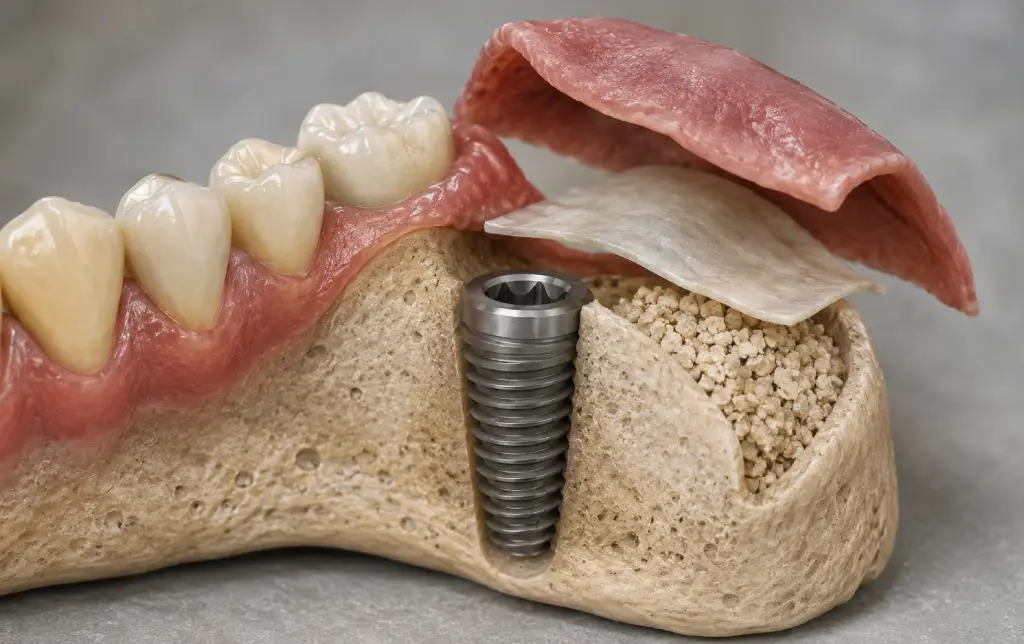
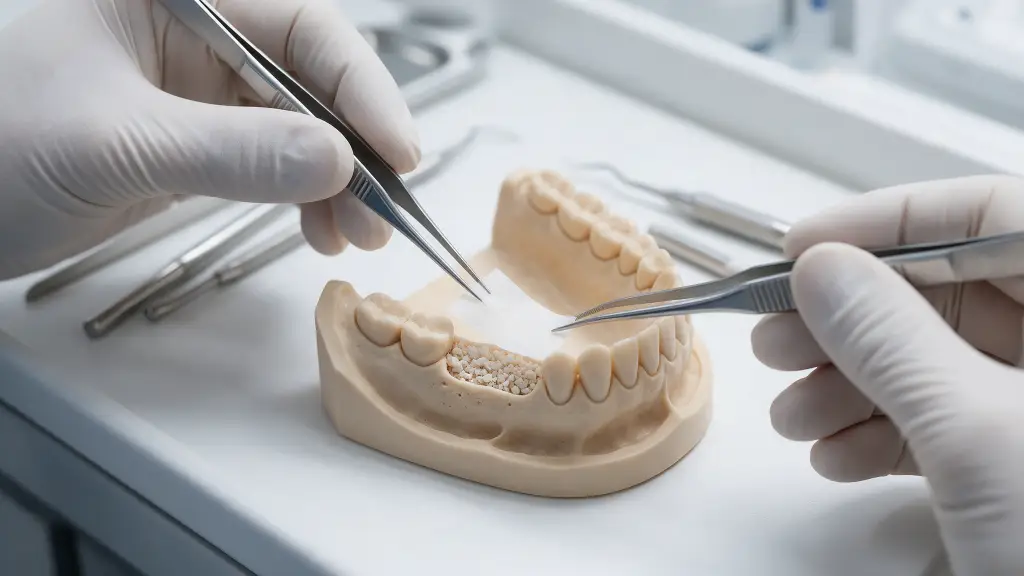
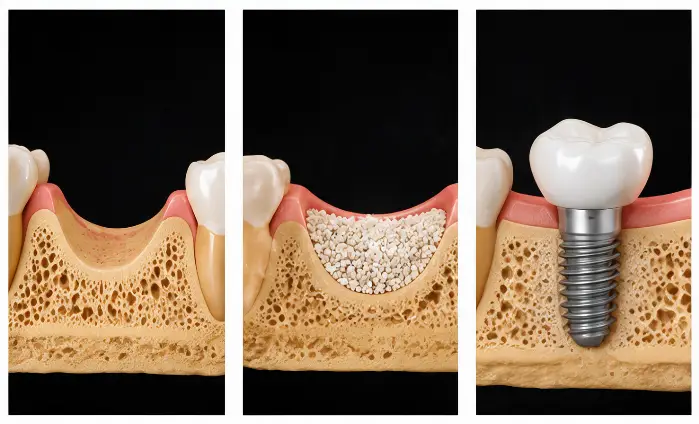
GBR means placing grafting material where bone is missing and covering it with a membrane. The membrane keeps the soft tissue out, so bone has room to grow into the space.
Peri-implant GBR is the same idea used around an implant, where there is a thin patch that needs filling in as the implant goes in.
- Grafting material fills the gap
- A membrane protects the space
- New bone grows in over months
- Can be done alongside the implant
Six to nine months, usually
Grafted bone generally needs six to nine months before it can hold an implant. There is no way to rush it. Bone heals at the speed bone heals.
For a UK patient that changes the shape of the whole treatment, so we would rather you knew now than at your first appointment.
- Six to nine months of healing
- Implant placed afterwards
- Sometimes done at the same time
- Scan decides which
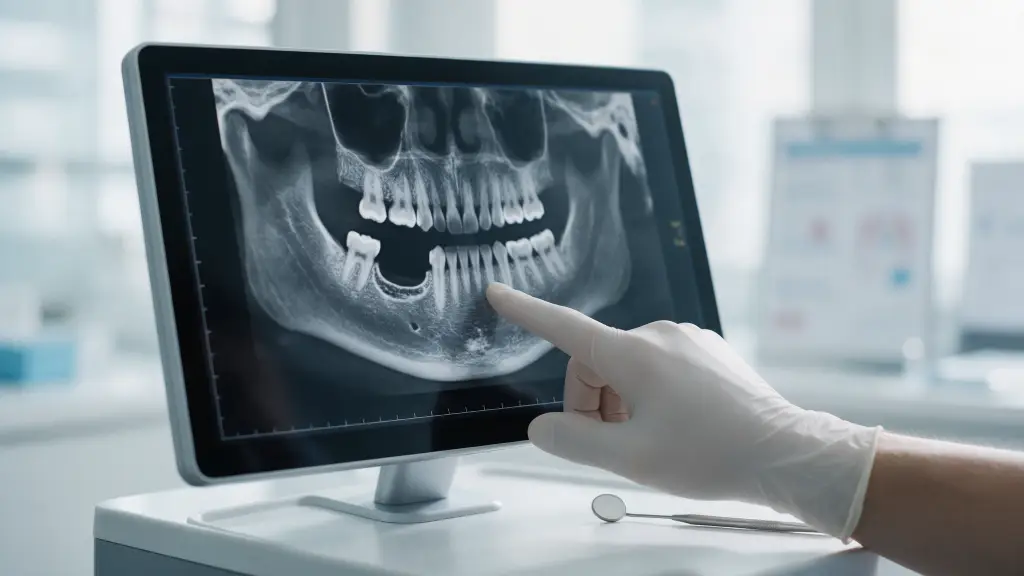
What thin bone actually looks like
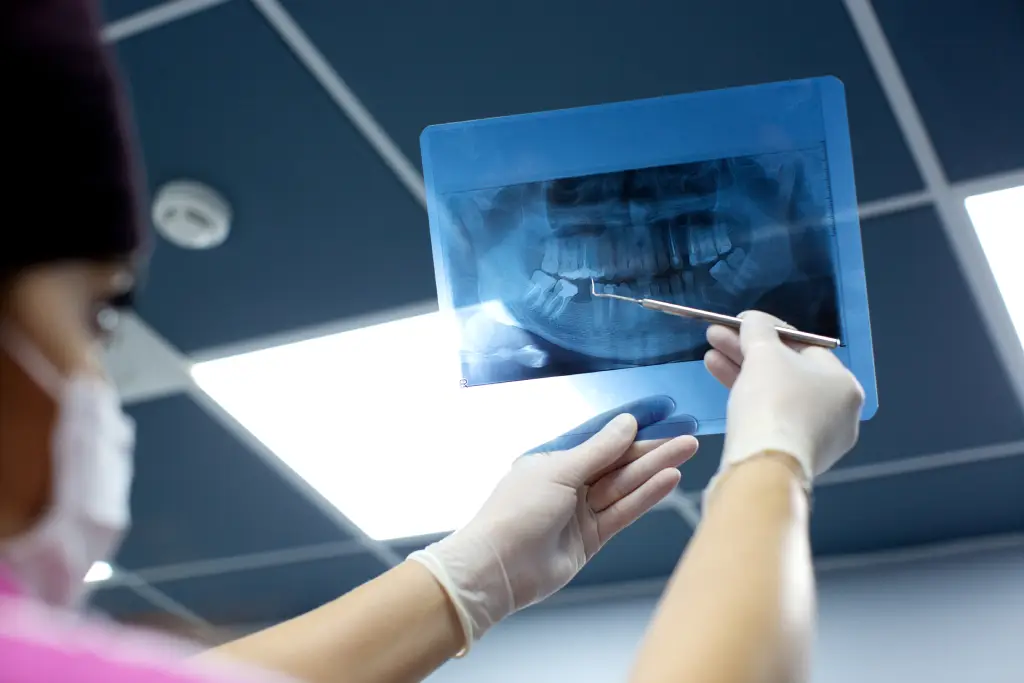
A scan makes it obvious in a way that words do not.
Procedure — interactive step-through
Honestly, the timeline varies: a new tooth can be ready within hours in the best case, or take the better part of a year in the most involved one. Step through the sequence.
Scan
A CBCT scan measures how much bone you have and where. That measurement decides whether grafting is needed at all.
Placing the graft
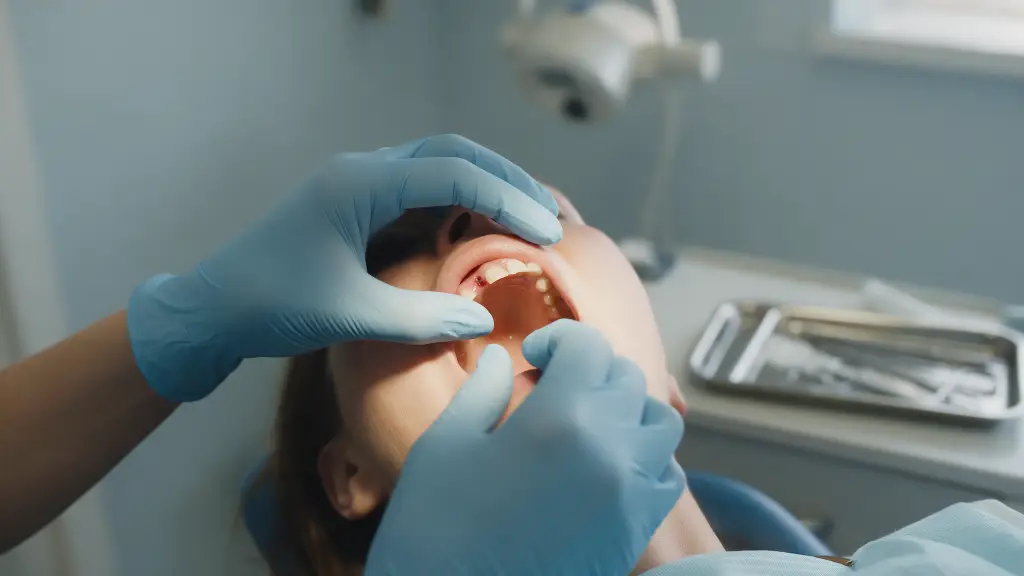
Under local anaesthetic, or a general if you prefer. The gum is opened, grafting material is packed into the thin area, and a membrane is laid over it. The gum is then stitched closed.
Stitches out
Stitches come out at a check-up roughly a week later.
New bone forms
The graft turns into bone that can hold an implant. This is the long wait, and it cannot be shortened.
The implant goes in
Once a scan confirms the bone has taken, the implant is placed as normal, and then heals for a further three to four months.
We publish our price list
Most people considering treatment abroad have never seen the building they would be walking into. Here is ours.
ADDITIONAL WORK, ONLY WHERE THE MOUTH NEEDS IT +
Prices are indicative. The exact price of your treatment is worked out at your first consultation, once we have seen the X-rays. GBP figures are converted for guidance at about 427 HUF to the pound.
Not sure whether you need an implant at all?
Send an X-ray, or three photos on your phone. A dentist will look at it and write back with a provisional plan and an indicative price — before you commit to anything, and before you book a flight.
Coordinators 8am–7pm Mon–Fri, Budapest time (7am–6pm UK).
You are choosing a dental team, not a country
Dr. Zoltán Óvári
FOUNDER & CLINICAL LEAD
Éva Vas
Chief Operating Officer
Judit Butskó
Financial Director
Dr. Melinda Kálcsev
Conservative Dentistry, Endodontics
Dr. Gabriella Juhász
Orthodontics
What our patients say about CosmoDent
“I was nervous about visiting an unfamiliar clinic, but I had a great experience. The clinic was clean, modern and stylish, and my doctor did an amazing job.”
“Arrival, airport pickup and appointment scheduling went very smoothly. Dr Ecsegi was highly competent, and I felt well cared for during my treatment.”
“I had been an extremely anxious patient for many years and carefully researched clinics before choosing CosmoDent. I’m incredibly happy with my experience.”
“The perfect dental clinic! Several dentists told me they couldn’t replace my two front teeth with implants following an accident—but CosmoDent helped me.”
“This was by far the best dental experience of my life. I travelled to Budapest after weeks of pain and difficult experiences with several dental clinics in Paris.”

Excellent — 4.9 out of 5 from 250+ Google & Facebook reviews

Bone grafting and GBR, answered
Does everyone need a graft?
No. It is only needed where there is not enough bone to hold an implant firmly, and the scan tells us that in minutes.
Where does the graft material come from?
It can be your own bone, with small chips collected from another part of your jaw. Or it can be a prepared graft material: a xenograft (animal-derived) or an alloplast (synthetic). Your own bone grows into the material as it heals. Your scan shows which one you need.
Does it hurt?
It is done under local anaesthetic so you should not feel it. Expect some swelling for a few days afterwards, much like having a tooth out.
Can the graft and implant be done together?
Sometimes, where the shortfall is small. Where a lot of bone is missing, the graft has to heal first.
Why does it take six to nine months?
Because bone grows slowly. There is no technique that makes new bone form faster, and anyone promising otherwise is selling something.
Can a graft fail?
It can, though it is uncommon. If it does, we scan again and talk through the options.
Will I need extra trips to Budapest?
It is 100% certain, even is an implant is placed simontanously, it needs a denture/bridge on top of it.
Is there an alternative?
Sometimes. All-on-4 uses angled implants to reach solid bone and can avoid grafting altogether, which is worth asking about.
Find out where you stand
Upload a panoramic X-ray if you have one. If not, three clear phone photos are enough to start. A dentist reviews what you send and you receive a written provisional plan with an indicative price.
No obligation, no deposit, and no need to travel to find out whether an implant is even the right answer.
Prefer to talk? Call our UK number on +44 7418 609 304, or our Budapest clinic on +36 1 200 13 78. You can also email us at info@cosmodent.hu.