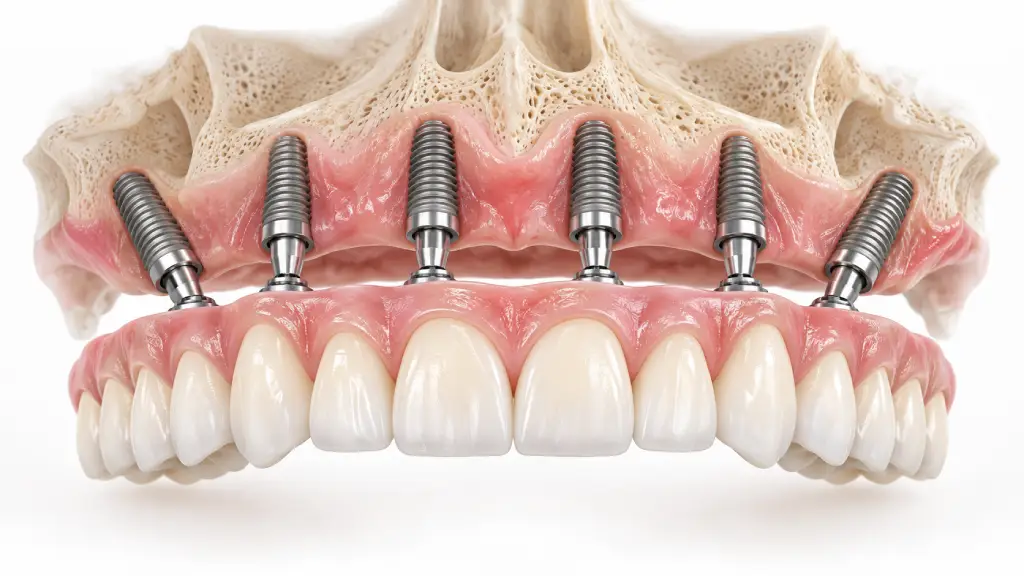
Two more implants than All-on-4, spread further back along the jaw. More anchors, more even load, and the option of a heavier bridge in solid zirconia.
Send an X-ray or three phone photos. A dentist reviews them and writes back with a provisional plan.
Implants
0K+
Crowns
0K+
In Budapest
0 Years+
Dentists
0 Specialist
START HERE
The three things worth knowing first
Six anchors instead of four
Six implants go into the jaw and one fixed bridge sits across all of them. The extra pair sits further back, so the bridge is supported closer to where you actually chew.
That extra support is what allows a heavier, stronger bridge on top. It also means the work is not resting on fewer points than it needs to.
When there is bone to work with
All-on-6 asks more of your jaw than All-on-4 does. You need enough bone in more places. Where that bone is there, the extra support is worth having.
The scan settles it. Nobody can tell you which is right for you from a photograph or over the phone.
You have reasonable bone across the jaw
You want the strongest fixed option
You grind your teeth or have a heavy bite
You are replacing an older bridge that has failed
Zirconia, made here
Our premium package uses solid zirconia. It is hard, it does not stain, and it holds its colour. Our own technicians build it in the laboratory downstairs.
Because the lab is in the building, adjustments happen while you wait rather than in a courier van.
Solid zirconia bridge
Made in our on-site laboratory
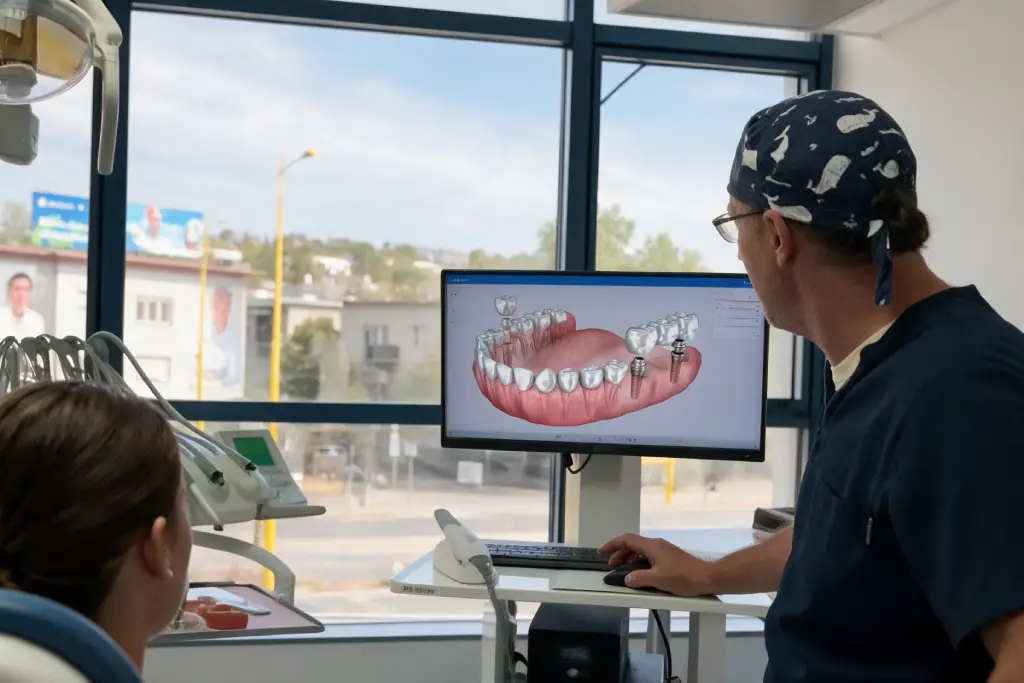
Bite planned with Modjaw
German quality assurance system
YOUR OPTIONS
Hear it from someone who has been through it
A full mouth rebuild is a big decision. It helps to hear how it actually went for someone else.
THE PROCEDURE
Procedure — interactive step-through
Honestly, the timeline varies: a new tooth can be ready within hours in the best case, or take the better part of a year in the most involved one. Step through the sequence.
FIRST VISIT
Scans and a plan
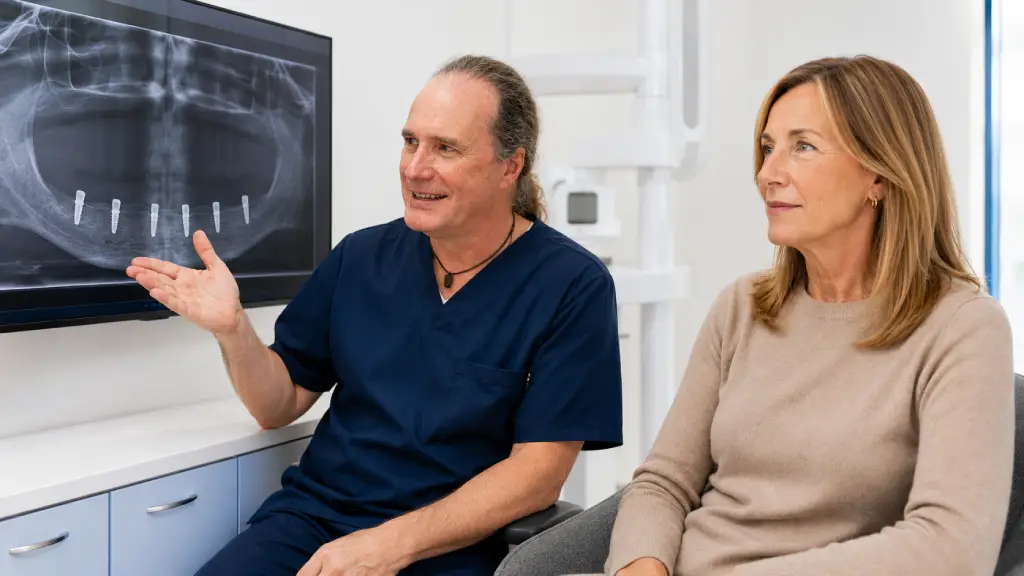
A CBCT scan maps the bone along the whole jaw. We plan six positions that share the load evenly, and check there is bone to hold each one.
ONLY WHERE NEEDED
Extractions or grafting
Failing teeth are removed. Thin areas are built up first. Grafted bone needs six to nine months before implants go in.
SURGERY
Placing six implants
Under local anaesthetic, or a general if you prefer. The gum is opened, six sites are prepared, and the implants are fitted. Stitches come out about a week later.
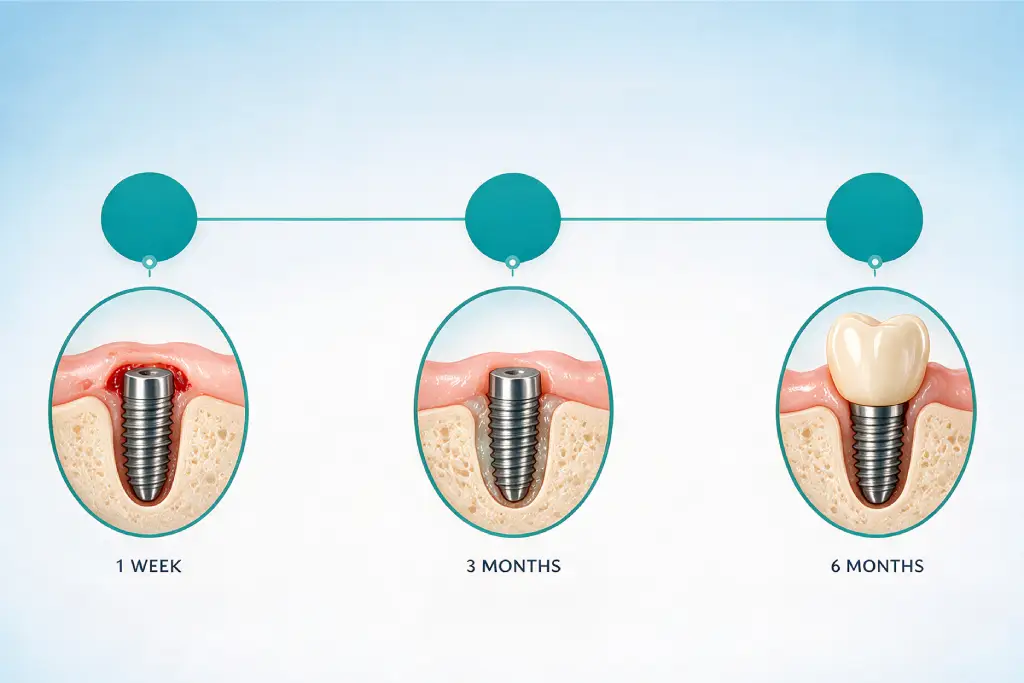
THREE TO SIX MONTHS
Healing
The bone grows onto each implant and locks it in place. Three to four months, longer after a graft.
FINAL VISIT
Fitting the zirconia bridge
The bridge is built here, tried in, adjusted until the bite is even across all six, then fixed.
THE COST
We publish our price list
Most people considering treatment abroad have never seen the building they would be walking into. Here is ours.
Dental Implants
Price Per Implant
Price Per Tooth
Full Mouth Dental Implants
£559
£360
(24 Teeth)
All On 4 Dental Implants
£559
£750
(12 Teeth)
All On 6 Dental Implants
£559
£880
(12 Teeth)
3 On 6 Dental Implants
£559
£880
(12 Teeth)
Single Tooth Implant
(Implant, Abutment, Crown)
£559
£360
(24 Teeth)
Camlog Implant
(without Abutment, without Crown, without GBR)
£559
N/A
Zirconia Metal-Free Implant with Zirconia Crown
(without GBR)
£1,430
N/A
Bone Grafting or Peri-Implant GBR
£335
N/A
Sinus Lift Under Implant
£260
N/A
Tight Gum Training
£170
N/A
Implant Removal
£100
N/A
Dentures
Proposed GBP
Unit
Prosthesis full acrylic
£525
treatment
Prothesis with full metal insert
£600
treatment
Partial metal plate prosthesis
£525
treatment
Partial underlining
£90
per jaw / chairside
Full underlining
£125
per jaw
Prosthetic fracture repair
£70
repair
Prosthetic tooth replacement
(first tooth)
£70
first tooth
Orthodontics
Proposed GBP
Unit
Treatment plan and quote
£85
N/A
Impressions
£25
N/A
Virtual treatment plan for ClearCorrect aligners
£110
N/A
Myofunctional trainer
£205
N/A
Removable functional appliance (both arches)
£410
N/A
Removable active plate (one jaw)
£290
N/A
Conventional fixed metal braces
£680
per arch
Self-ligating fixed metal braces
£955
per arch
Ceramic fixed braces (conventional or self-ligating)
£1,090
per arch
Clear aligners – ClearCorrect One
£1,780
treatment
Clear aligners – ClearCorrect Unlimited
£3,960
treatment
Appliance modification – aesthetic
£65
N/A
Appliance modification – removable
£30
N/A
Appliance modification – fixed
£45
N/A
Broken archwire replacement
£15
N/A
ADDITIONAL WORK, ONLY WHERE THE MOUTH NEEDS IT +
Prices are indicative. The exact price of your treatment is calculated at your first consultation, once we have seen the X-rays. GBP figures are converted for guidance at approximately 427 HUF to the pound.
Not sure whether you need
an implant at all?
Send an X-ray, or three photos on your phone. A dentist will look at it and write back with a provisional plan and an indicative price — before you commit to anything, and before you book a flight.
“I was nervous about visiting an unfamiliar clinic, but I had a great experience. The clinic was clean, modern and stylish, and my doctor did an amazing job.”
Daria Savinova
“Arrival, airport pickup and appointment scheduling went very smoothly. Dr Ecsegi was highly competent, and I felt well cared for during my treatment.”
Peter Pahle
“I had been an extremely anxious patient for many years and carefully researched clinics before choosing CosmoDent. I’m incredibly happy with my experience.”
Michael Sauer
“The perfect dental clinic! Several dentists told me they couldn’t replace my two front teeth with implants following an accident—but CosmoDent helped me.”
Balázs Sótér
“This was by far the best dental experience of my life. I travelled to Budapest after weeks of pain and difficult experiences with several dental clinics in Paris.”
Alexander Sarvaan
Excellent — 4.9 out of 5 from 250+ Google & Facebook reviews
COMMON QUESTIONS
All-on-6 dental implants, answered
Is All-on-6 better than All-on-4?
Neither is better for everyone. With six implants, the bite is spread across more support points, so each implant carries less load. You also have more in reserve if one ever has a problem. That’s why six is often chosen for the upper jaw, where the bone is softer. All-on-4 tilts the back two implants to make the most of the bone you have, which can avoid bone grafting. We recommend one or the other once we’ve seen your CBCT scan.
Do I need more bone for six implants?
Usually, yes. Six implants need enough healthy bone along the whole arch, including further back, where the upper jaw often has less bone because of the sinuses. If your scan shows there isn’t enough, there are two routes. One is bone grafting or a sinus lift to build it up. The other is All-on-4, which uses angled implants to avoid the areas with less bone. We explain both, and what each would cost, at your assessment.
What is the bridge made of?
An All-on-6 dental implant bridge can be made from materials such as zirconia, acrylic or porcelain supported by a titanium framework. The material used depends on your treatment plan and the type of restoration recommended by your dentist.
Can I have six on top and four below?
Yes, and it’s a common combination. The upper jaw has softer bone, so an extra two implants add support there. The lower jaw is denser, and four implants are often enough. Each arch is planned separately from your scan, and each arch is priced on its own.
How long will I be in Budapest?
Most cases need two trips, a few months apart. The first trip is maximum 5 nights. We finalise your plan, place the implants and fit your fixed temporary bridge, so you fly home with teeth in place. You then heal at home for around [3–6] months while the implants bond with the bone. The second trip is 7 nights, to fit your final bridge. If you need bone grafting or a sinus lift, you may need a longer stay or an extra visit. Your treatment plan confirms the exact number of trips and nights before you book flights.
Does it hurt?
The surgery is done under local anaesthetic [confirm whether sedation is offered]. You’ll feel pressure, but you shouldn’t feel pain while it’s happening. Afterwards, expect swelling, tenderness and sometimes bruising for several days. Most patients manage this with standard painkillers and a soft diet. Before you go home, we give you written aftercare instructions and a direct contact in case anything concerns you.
Is a zirconia bridge worth the extra?
For many patients, yes. Zirconia is very strong and doesn’t wear down or stain. It also keeps a natural, tooth-like appearance for many years. An acrylic bridge costs less up front, but it’s softer. The teeth can wear or chip over time and may need repairing or replacing. That cost adds up over the life of the bridge. Acrylic can still be the right choice for some people, depending on their bite and budget. The difference for your case is [€X per arch], and we’ll show you both prices side by side.
FREE ONLINE ASSESSMENT
Find out where you stand
Upload a panoramic X-ray if you have one. If not, three clear phone photos are enough to start. A dentist reviews what you send and you receive a written provisional plan with an indicative price.
No obligation, no deposit, and no need to travel to find out whether an implant is even the right answer.