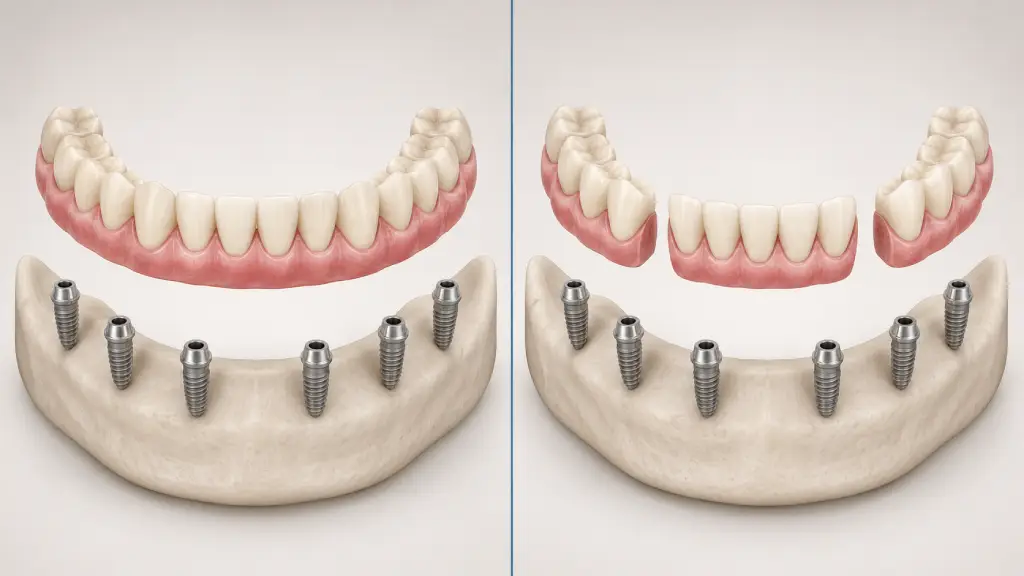
Instead of one long bridge across the whole jaw, the work is split into three shorter sections. If something goes wrong in one section, only that section has to come off.
Send an X-ray or three phone photos. A dentist reviews them and writes back with a provisional plan.
Implants
0K+
Crowns
0K+
In Budapest
0 Years+
Dentists
0 Specialist
START HERE
The three things worth knowing first
The jaw split into three
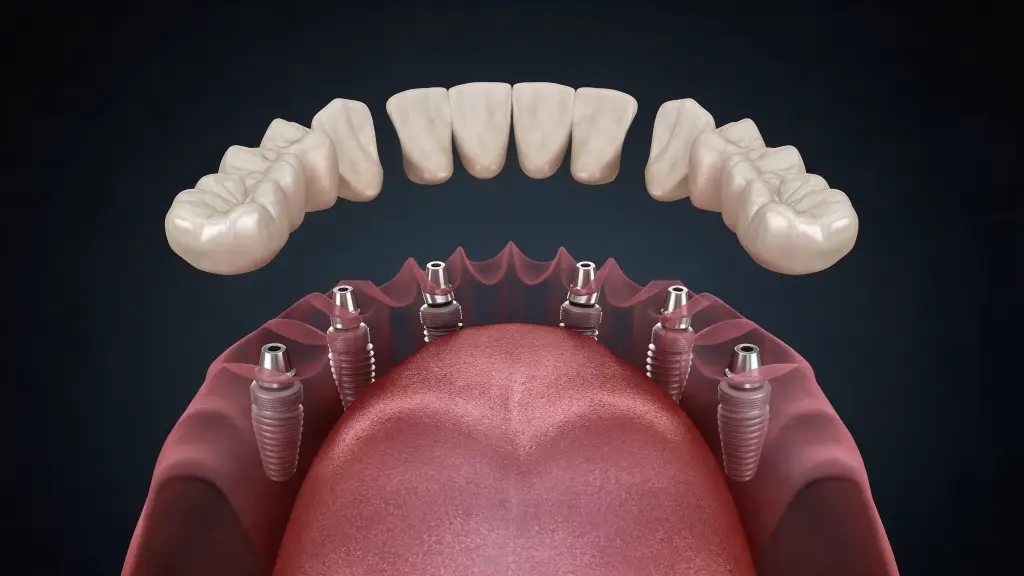
Six implants go into the jaw, as they would for All-on-6. The difference is what sits on top. Rather than one bridge spanning everything, three shorter bridges each sit on a pair of implants.
The thinking behind it is repair. A single long bridge is one object. Damage any part of it and the whole thing comes off. Three sections mean a problem stays local.
People thinking about the long run
This approach appeals to patients who want their treatment to be easy to service in ten years, not just easy to fit now.
It suits a jaw with even bone across its length, because all six implants have to sit in usable bone.
You want repairs to stay local
You have even bone across the jaw
You are replacing a long bridge that failed as one piece
You want to keep future options open
Against one long bridge
A single full-arch bridge is simpler to make and usually costs less. Three sections cost more to produce, because there are three separate pieces of work.
What you buy with that difference is easier repair later. Whether that trade is worth it depends on your bite, your bone and how you feel about future maintenance.
Three pieces instead of one
Repairs stay in one section
More laboratory work involved
Needs six implants in solid bone
YOUR OPTIONS
Hear it from someone who has been through it
A full mouth rebuild is a big decision. It helps to hear how it actually went for someone else.
THE PROCEDURE
Procedure — interactive step-through
Honestly, the timeline varies: a new tooth can be ready within hours in the best case, or take the better part of a year in the most involved one. Step through the sequence.
FIRST VISIT
Scans and a plan
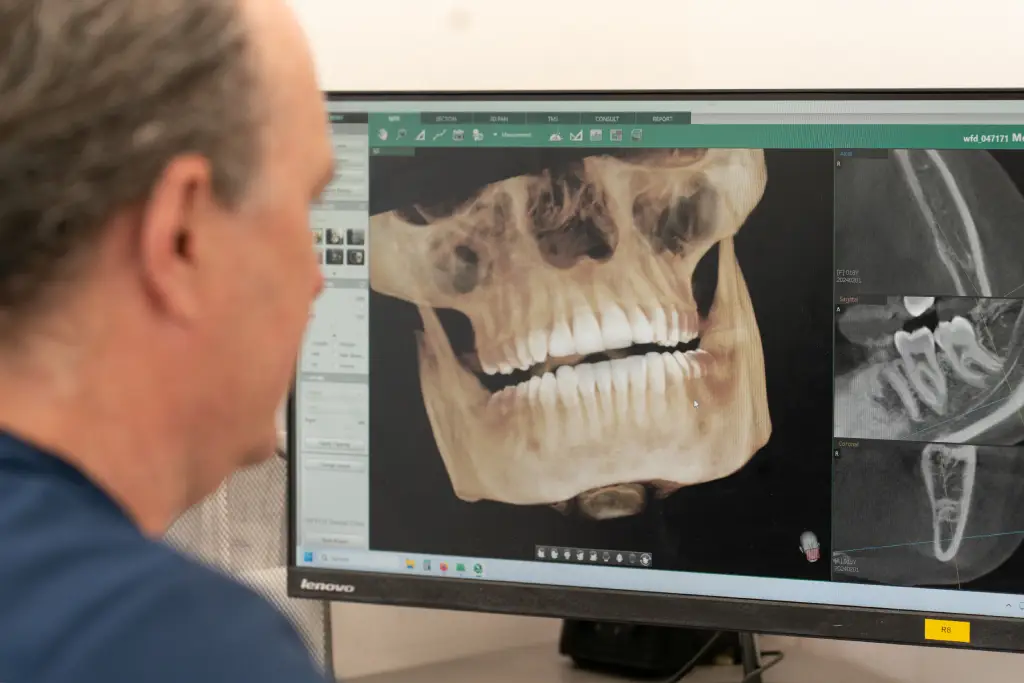
A CBCT scan checks there is bone for all six positions. The three bridge sections are planned around where that bone actually is.
ONLY WHERE NEEDED
Extractions or grafting
Teeth that cannot stay come out. Thin bone is built up and left six to nine months to heal.
SURGERY
Placing six implants
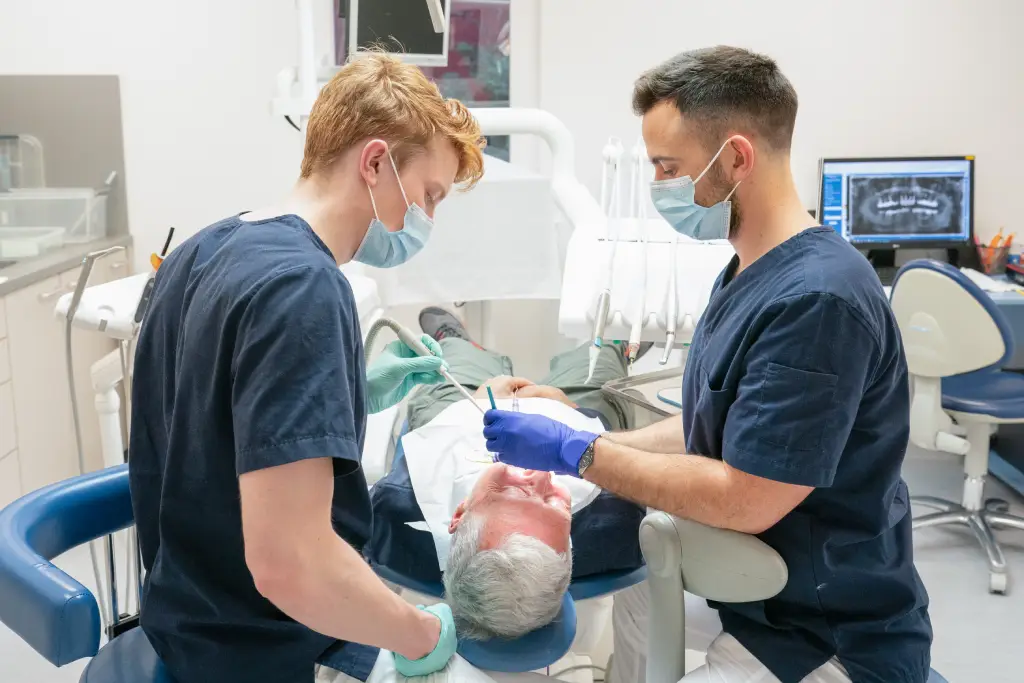
Six implants are fitted, spaced so each pair can carry its own section. Under local anaesthetic, or a general if you prefer.
THREE TO SIX MONTHS
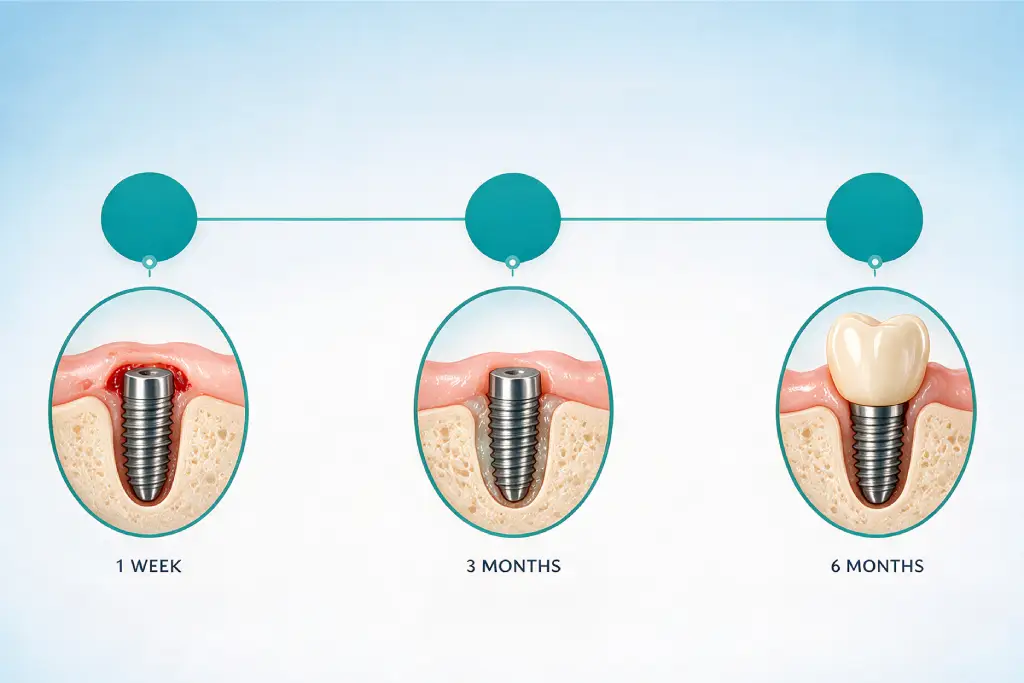
Healing
The bone grips each implant over three to four months. Longer if you had a graft.
FINAL VISIT
Fitting three bridges
Each section is made, tried in and adjusted so the bite is even across all three, then fixed onto its implants.
THE COST
We publish our price list
No price has been confirmed for this treatment. The figures below are the confirmed component costs it would be built from.
Dental Implants
Price Per Implant
Price Per Tooth
Full Mouth Dental Implants
£559
£360
(24 Teeth)
All On 4 Dental Implants
£559
£750
(12 Teeth)
All On 6 Dental Implants
£559
£880
(12 Teeth)
3 On 6 Dental Implants
£559
£880
(12 Teeth)
Single Tooth Implant
(Implant, Abutment, Crown)
£559
£360
(24 Teeth)
Camlog Implant
(without Abutment, without Crown, without GBR)
£559
N/A
Zirconia Metal-Free Implant with Zirconia Crown
(without GBR)
£1,430
N/A
Bone Grafting or Peri-Implant GBR
£335
N/A
Sinus Lift Under Implant
£260
N/A
Tight Gum Training
£170
N/A
Implant Removal
£100
N/A
Dentures
Proposed GBP
Unit
Prosthesis full acrylic
£525
treatment
Prothesis with full metal insert
£600
treatment
Partial metal plate prosthesis
£525
treatment
Partial underlining
£90
per jaw / chairside
Full underlining
£125
per jaw
Prosthetic fracture repair
£70
repair
Prosthetic tooth replacement
(first tooth)
£70
first tooth
Orthodontics
Proposed GBP
Unit
Treatment plan and quote
£85
N/A
Impressions
£25
N/A
Virtual treatment plan for ClearCorrect aligners
£110
N/A
Myofunctional trainer
£205
N/A
Removable functional appliance (both arches)
£410
N/A
Removable active plate (one jaw)
£290
N/A
Conventional fixed metal braces
£680
per arch
Self-ligating fixed metal braces
£955
per arch
Ceramic fixed braces (conventional or self-ligating)
£1,090
per arch
Clear aligners – ClearCorrect One
£1,780
treatment
Clear aligners – ClearCorrect Unlimited
£3,960
treatment
Appliance modification – aesthetic
£65
N/A
Appliance modification – removable
£30
N/A
Appliance modification – fixed
£45
N/A
Broken archwire replacement
£15
N/A
Not sure whether you need
an implant at all?
Send an X-ray, or three photos on your phone. A dentist will look at it and write back with a provisional plan and an indicative price — before you commit to anything, and before you book a flight.
“I was nervous about visiting an unfamiliar clinic, but I had a great experience. The clinic was clean, modern and stylish, and my doctor did an amazing job.”
Daria Savinova
“Arrival, airport pickup and appointment scheduling went very smoothly. Dr Ecsegi was highly competent, and I felt well cared for during my treatment.”
Peter Pahle
“I had been an extremely anxious patient for many years and carefully researched clinics before choosing CosmoDent. I’m incredibly happy with my experience.”
Michael Sauer
“The perfect dental clinic! Several dentists told me they couldn’t replace my two front teeth with implants following an accident—but CosmoDent helped me.”
Balázs Sótér
“This was by far the best dental experience of my life. I travelled to Budapest after weeks of pain and difficult experiences with several dental clinics in Paris.”
Alexander Sarvaan
Excellent — 4.9 out of 5 from 250+ Google & Facebook reviews
COMMON QUESTIONS
3-on-6 dental implants, answered
Is All-on-6 better than All-on-4?
Neither is better for everyone. All-on-6 can provide broader support across the arch and may be especially useful in the upper jaw, where the bone is often softer. All-on-4 can make efficient use of the available bone and may help avoid grafting in suitable cases. The best option depends on your bone quality, anatomy, bite and clinical assessment, together with the CBCT scan.
Do I need more bone for six implants?
You need enough suitable bone to support six implants in the planned positions. In some cases this can be achieved without grafting, including by using angled implants where appropriate. If the available bone is insufficient, bone grafting, a sinus lift or a different implant concept may be recommended. A CBCT scan and clinical assessment will show which option is suitable for you.
What is the bridge made of?
For our All-on-6 treatment, the final fixed bridge is typically made from zirconia. It is planned digitally and produced in our on-site dental laboratory, allowing the dentist and dental technician to work closely together on the fit, bite and aesthetics. The exact design is confirmed according to your individual treatment plan.
Can I have six on top and four below?
Yes. In fact, six implants in the upper jaw and four in the lower jaw is one of the combinations we recommend most frequently because of the typical anatomical differences between the two jaws. The upper jaw often has softer bone and may benefit from the additional support of six implants, while the denser bone of the lower jaw can often provide sufficient support with four. Each arch is nevertheless assessed and planned individually based on the bone conditions, bite, clinical examination and CBCT scan.
How long will I be in Budapest?
Most cases need two trips, a few months apart. The first visit usually takes up to 5 days. We finalise your treatment plan, place the implants and, in many cases, fit a fixed temporary bridge, so you can return home with fixed temporary teeth in place. You then heal at home for around 3–6 months while the implants integrate with the bone.
The second visit is longer and may take up to around 11 days, as this is when the final aesthetic and functional design is completed, the trial setup is checked with you, and the definitive bridge is produced and fitted. In some cases, this second phase can instead be divided into two shorter visits with around 7–10 days between them.
If additional procedures such as bone grafting or a sinus lift are required, the timing may need to be adjusted. Your individual treatment schedule is confirmed before you book your travel.
Does it hurt?
The procedure is carried out under local anaesthetic, and sedation or general anaesthesia can also be arranged if appropriate. You should not feel pain during the surgery, although you may feel pressure or movement. Afterwards, some swelling, tenderness and occasionally bruising are normal for a few days and can usually be managed with the medication and aftercare instructions we provide.
Is a zirconia bridge worth the extra?
If you have fixed, screw-retained implant bridges in both jaws, we recommend zirconia for the final restorations. Because monolithic zirconia has no separate veneering layer, the risk of chipping is very low, and it is far more resistant to wear than veneered or acrylic-based restorations. Clinically, chipping and wear are much more common when these softer or layered materials oppose another rigid fixed implant bridge.
If the opposing jaw has a removable implant-supported denture, a veneered restoration can also be suitable, because the removable prosthesis — although it can be very stable — is less rigid and usually has acrylic teeth.
FREE ONLINE ASSESSMENT
Find out where you stand
Tell us what you would like help with. If you have a recent panoramic X-ray or dental photos, you can upload them too — the more information we have, the more accurately we can assess your case. A dentist will review the information you provide and, where possible, give you an initial idea of suitable treatment options and indicative costs before you travel.
Keep: No obligation, no deposit, and no need to travel to find out whether an implant is even the right answer.